For Grandma and Oma
Sunday, July 02, 2006
Eucharistic Meditation
Jesus says: “Can the friends of the bridegroom fast while the bridegroom is with them? As long as they have the bridegroom with them they cannot fast. But the days will come when the bridegroom will be taken away from them, and then they will fast in those days. No one sews a piece of unshrunk cloth on an old garment; or else the new piece pulls away from the old, and the tear is made worse. And no one puts new wine into old wineskins; or else the new wine bursts the wineskins, the wine is spilled, and the wineskins are ruined. But new wine must be put into new wineskins." (2:19-22)
Jesus is the bridegroom and Israel, personified in the Pharisees, is the “old garment” and the “old wineskins”. Jesus is the “unshrunk cloth” and the “new wine”. Notice what Jesus is saying must happen: If He is not “shrunk” first, the garment will become torn worse. And if the wineskins are not made new, the new wine (Jesus) will burst them. Jesus must be “shrunk” and Israel must be made “new”. If this does not happen, Israel will be torn (“divided/schism”) and burst (“shed/spilled”). But as the Redeemer of Israel, Jesus comes to stand in Israel’s place. The bridegroom will be taken from His friends when the old garment/Israel does not accept the new garment /Jesus. He will be torn (in their place) and die. Likewise, Jesus will become the old wineskins/Israel and shed His wine/blood in their place. And Jesus uses the very same word in Mark 14: “This is My blood of the new covenant, which is shed for many” (Mk. 14:24). His blood/wine will be “shed/spilled” in their place. But new wine must be put into new wineskins, and so the Israel that believes will be made into the new wineskins, and the resurrected and ascended Lord, as the new wine/Holy Spirit of God, will fill them.
And here you are two thousand years later, new wineskins all, wineskins that will never be ruined, and here Jesus still gives Himself, gives us His new wine/blood, filling us up to the brim.
Mark 2: Building a New House
Introduction
The coming of Jesus is the inauguration of a new Kingdom, a new Israel, and ultimately a new world. Mark displays this through subtle details and sporadic, radical claims. This is the God of Israel remodeling His house, remaking His people.
In the House
Mark is quite interested in giving us particular kinds of details that really seem unnecessary. Notice all the “going in” and “going out” thus far (Lk. 1:12, 21, 29, 35; 2:1, 15; 3:1). The fist place Jesus enters is a synagogue and it has a man with an unclean spirit. He next enters Simon’s Mother-in-law’s house to heal her, and now he has apparently returned to her house in Chapter 2 where yet more healing is taking place. The picture of a house should immediately make us think of Israel. Israel is called a house throughout the Old Testament. And the most prolific uses of this title are throughout the Prophets. The title should remind us of the tabernacle/temple where God made His home with the people of Israel. Israel became a house when God came to dwell with them. To refer to the “house of Israel” is for God to call them by their origin, by their history, by the covenant, by their last name. Israel is a house, an infected house, a defiled, sick and lame house, and Jesus is claiming to be a new house, a new Temple where the unclean can be cleansed and sins can be forgiven (1:41-42, 2:5)
Son of Man
Not only is Jesus claming to be a new Temple, he also give Himself the title “Son of Man” (2:10, 2:28). The title is not unique or new to the New Testament. Throughout the Old Testament it could literally be rendered “Son of Adam”. This means that the title should probably first indicate authority. Adam was given the authority to rule, guard, and fill the world. This same authority is recalled in the Psalms (Ps. 8, 80, 145) and promised by Daniel to be reclaimed (Dan. 7:13-14). But “Son of Adam” is also a title of humility, particularly of being a creature (Num. 23:19, Job 25:6). The first son of Adam was of course Cain, and that should not be forgotten either. The most prolific use of the title is in Ezekiel where Ezekiel is called “son of Adam” throughout. For Jesus to take this title is for Him to be claiming to be an Ezekiel in some fashion. Ezekiel largely spent his ministry enacting the massive transition that was happening and about to happen to Israel (playing a ‘shut in’, laying siege against a clay picture of Jerusalem on his left side for many days, cooking bread over feces and eating it, shaving his head and beard and burning the hair in the city square, packing bags and climbing through a hole in the city wall, eating fearfully, loudly sighing, clapping hands, losing his wife, preaching against objects and various directions). Ezekiel’s ministry was one of playing “Israel”, and thus Jesus is now claiming to be Israel too: a man of authority, a man of the earth, and a man acting out the extraordinary transition that is about to take place.
The Bridegroom
Jesus continues the Ezekiel theme by speaking and enacting riddles before his audience, claiming to be a bridegroom in response to his disciples’ dietary habits and discussing the principles of mending and fermentation. His answer not only insists that eating and drinking is the right thing to do, but also insists that something radically new is beginning and that Israel will have to change in order to accept it (2:21-22). This is what bridegrooms do: they have asked a woman to become something very new. And this is precisely what Jesus is doing: Jesus is forgiving sins, something that could normally only happen at the temple (Mk. 2:5, Lev. 4-5). Jesus sets his own festival calendar, an amendment of Levitical law (Lev. 23), feasting with sinners and not joining the fast of John and the Pharisees. Finally, Jesus does not follow their traditions relating to the Sabbath. Notice that Jesus defends His Sabbath keeping with reference to David’s actions while fleeing from Saul. If Jesus is the House of Israel, the Son of Man, and David fleeing from Saul (a Pharaoh) then Jesus is the new temple offering forgiveness and cleansing, the new Israel preparing for the death of exile and the resurrection of return, and a King in exile, preparing to usher in a new Kingdom.
Applications
There are three houses that show up in Mark 2. From these and the circumstances that surround them we might begin to explore a theology of home, something our culture desperately needs.
A home is a place of forgiveness and healing (2:1-12). Bitterness and grudges can have no place in a Christian home. The writer of Hebrews warns us to take care lest any root of bitterness spring up, which is able to defile many. Confess your sins; forgive one another; keep short accounts.
A home is place for eating and fellowship (2:13-22). Where do you spend the most time as a family? The table is not just for feeding your bodies; food is not just an unfortunate anatomical necessity. The Lord’s Supper teaches us that food is grace. And good food shared is an opportunity to feed souls.
A home is a place of refuge and rest (2:23-28). Unfortunately many homes are where the fighting is the fiercest. But this should not be so. Bickering, complaining, nagging, and competitive spirits have no place in a Christian home anymore than a soldier has the right to return to the barracks guns blazing. You’re on the same team.
As we seek to recover a Christian culture, our homes—by grace through faith—must become glorious imitations of the House of God.
In the Name of the Father, and of the Son, and of the Holy Spirit, Amen!
Exhortation
Idols and idolatry are almost meaningless terms to moderns. We hear St. John’s exhortation to keep ourselves from idols, and we think we’re safe because we haven’t been bowing down to any Buddha statues, sacrificing pigs to Baal or burning incense to Moloch in the last few weeks. In fact, we’ve probably never done any of those things. So when we think about idols we think we’re safe.
But the Bible is clear: idolatry is the root cause of cultural decline. Israel did not become the cesspool of the Middle East because she didn’t have her systematic theology straight. Of course Israel really did bow down before statues and she really did offer incense on every green hill and she really did cause her children to pass through the fires of Moloch, but these were the external, cultural signs of a prior idolatry: the worship of acceptance, fame, respectability and status in the world. She wanted to be like all the other nations around her, and in the end she was even worse than the pagan nations around her. Even they were embarrassed by her lewdness.
And it is no different today. You will not find Christians sprinkling blood before some black, lifeless statue. You will find Christians taking bribes to tell lies. You will see Christians doing obeisance to the gods of fashion, selling their children’s inheritance on credit cards, automobiles, houses and vacations. You will find Christians looking the other way, embarrassed to condemn sin and folly. You will find Christians offering up their children to be educated by god haters and pagans, defending the practice because, you know, ‘Daniel came out of the lions’ den unharmed.’ You will find Christians cheating on their taxes, overcharging for shoddy work and selling Jesus junk as though our faith is a commodity to be bought and sold. You will find Christians fawning before the gods of intellectual respectability, working feverishly to find ways to ignore what the Word of God plainly says about creation, human sexuality, and the protection of the weak and defenseless. And so, with John, I exhort you, “Little children, keep yourselves from idols.”
Friday, June 30, 2006
Another World
My son is a boy. He has legs and feet and he moves them all by himself as though they belonged to him. He owns a set of arms and hands too. He’s mastered the art of holding just two or three fingers up at a time. He’s an anatomical engineer. He fights, he cries, he tells stories and jokes, he even sings songs and can carry short tunes. Who is this person?
He’s sitting behind me in the car. My wife and I are conversing. I pause mid sentence to the sound of a spittle explosion from the back seat. In the rearview mirror I can make out hands and fists weaving excitedly through the air. Explosion follows explosion. Spittle mists through the cabin of our Subaru. The backseat is engulfed in war.
“Whatcha doin, Riv?” I ask.
“I’m fightin’”
“Who are you fightin?”
“Bad guys.”
“What bad guys?”
“Uuuummmm, I’m fightin’ draaagons aaand dinosaaaurs aaaand monsteeers.”
“Ok, good work.” Battle sounds resume. My wife and I pick our conversation up again. A couple of minutes later, the Doxology echoes out of the car seat, “Praise God from whom all blessings flow…!” after the initial introit, the words and melody are not as clear, but the battle must have been over and apparently he was the victor.
Running down the hallway, my son is swinging a drum stick; he calls out, “you wanna fight, dad?” I agree and he runs away. Reemerging from his room he is lugging a lacrosse stick behind him. “Play dad, play. You wanna fight?” I take the lacrosse stick.
“On guard!” Swords clash.
“I wanna sing…, I wanna sing…, I wanna sing…” He sings some nursery rhymes with us, but usually when he suggests singing, he’s going to ask for “Our Father”, “Praise God”, or “Blessed the man.” Those are the classics. Those are the regulars, the ordinary service music of each day. The usual liturgy has “Our Father” after breakfast and prayers. “Praise God” is after our post-dinner singing of a psalm or hymn. And “Blessed the man” closes his day after a book or two in bed. “I wanna sing…, I wanna sing…Our Father!”
I tell my son it’s time for bed. He looks up with wondering eyes. He points one finger up by his face and squints slightly, “Just one book?” I nod, “Just one book. Go pick out a book and go wait for me on your bed.” He hurries out of the room, his two arms straight down and back, steering the thing. I walk in a minute later. He’s waiting on his bed with a book. I remember something. “I’ll be right back; hang on just a second.” He looks up blankly. A minute or so later, I return. He’s still sitting on his bed, but his book is gone. “Where’s my book, daddy?”
“I don’t know, what did you do with it?” He shrugs. I look around. Then I notice him patting his blanket. I pull at the blanket and the book emerges. I’m shocked. My son has just played his first practical joke. He’s beaming ear to ear. I lavish my highest praises and tickle him for his genius. My son has just turned two and he’s already playing practical jokes on me.
My son’s hair, if you were to ask him yourself, is “in the trash.” After two years of little trims and slight ‘touch-ups’ he’s had his first full-on haircut. And this was the first without tears. “I’m being tough, dad?”
“Yeah,” I tell him, “you’re being tough.”
“You buzz my hair, dad?”
“Yeah,” I nod, “I buzzed you’re hair.”
One of my proudest moments being dad was a few weeks ago when we were sitting on the porch of a friend’s house, an hour or two after bedtime, enjoying the thick summer air of upstate South Carolina. Looking out into the dark, my son looked up and asked, “What’s out there, dad? Are there monsters?” I told him I didn’t think so, but I asked him, “What do you say to a monster if you see one?” Without a second thought he growled and said, “On guard!”
My son thinks he is a person. He uses words that I don’t remember teaching him, phrases I’m sure he heard somewhere. But he throws them at me like he owns them. These are my words, dad, and I will use them.
“Who was Joshua?” I ask him.
“He’s crageous.”
“What did he do?”
“Adam and Eve, daddy?” Everything always comes back to Adam and Eve for him. I guess everything really does go back to Adam and Eve.
“Who did Joshua fight?”
“Bad kings. I not fight ladies, dad?”
“That’s right, you only fight bad guys and monsters, and you can play fight with daddy or other boys if they have swords.”
“I not fight momma?”
“No, you protect and defend your mom.”
“Adam and Eve, daddy?”
“Yes, Adam and Eve disobeyed. They did not obey God.”
“I obey daddy? I say daddy, yessir! and mommy, yesmam!”
Little feet are walking into my room. I turn around. He is wearing a red shirt and grey basketball shorts. He has some bit of fabric wrapped around his upper torso. He turns and says: “I’m King!” And if I was not yet sure, he grits his teethe and adds in his gruffest voice, “I’m King of the World!”
My wife and I are bustling around, getting ready for church. A blow dryer is hanging off the bathroom sink, as on a gallows, still humming, swaying slightly, rejected for a curling iron or eye liner. I’m tying, now retying my tie. That little back piece always comes out longer than the front on the first try. My son is standing in the middle of the room, in the middle of the world. He’s holding a piece of Styrofoam, an ancient treasure, a holy relic of weeks gone by. He holds it up and says, “This is my body.” And without looking at anyone in particular, he breaks the foam board in half.
My sons walks into my room, “Hi dad. Havin’ a good day?” I peer at him through squinted eyes, “Who are you?”
“I’m Rio, dad. Who are you?”
“I’m dad. Who are you?”
“I’m, I’m, I’m…. ummm, ummmm…” He knows this game so he’s trying to come up with something good, “I’m… mom!”
“Really?”
“No!” He smiles.
“Who are you?”
“I’m, I’m, I’m… grandma!” A grin stretches across his face.
My wife is tucking him into bed. He’s talking about what he accomplished for the day. Swimming, playing toys, eating dinner, and reading books are the usual highlights. My wife informs him that she will be going to the grocery store tomorrow and asks what he would like. “Um, um, mayonnaise, um, meeeat, um, chickennnn, and steeeeak, asparagus, and, um, juice!” My son is already making grocery lists. He’s telling my wife that he would like asparagus from the store.
Who is this person? Where did he come from? I know, I know… I know where he came from. And I know who he is. But golly. An entire new world, a vast universe it seems, has emerged in my apartment. There were just two us, a shared world, a fairly tame universe, and then this small man began asking for asparagus and fighting dragons and playing practical jokes on me.
My wife is due with our second child at the end of July, and my suspicion is that it’s another person, another world, another universe getting ready to emerge.
Thursday, June 29, 2006
Catholics on the Bench
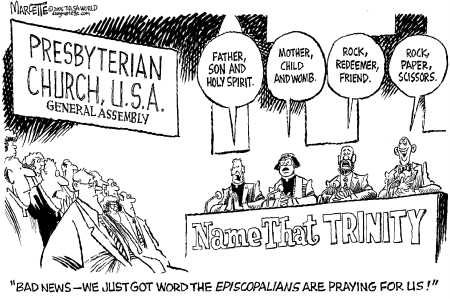
Robert F. Cochran Jr. points out that in the last 200 years of America's history there have only been seven Roman Catholics on the Supreme Court, and five of them have been appointed in the last twenty years.
Citing 'natural law', 'subsidiarity', and 'religious freedom', his thesis is that these doctrines found in Roman Catholic theology make the most appealing lawyers to the apparent gaping divide that has become the continuum of American politics. Cochran explains 'natural law' as a sort of marriage of special and general revelation, faith and reason, a middle ground between pure secularists and biblical theonomists. 'Subsidiarity' (it seems to me) is a social application of the doctrine of the Trinity. Cochran describes the doctrine as a recognition that societies work best were those nearest to the issues can be given freedom to work for their solutions, a middle ground between radical individualism and collectivism. Finally, 'religious freedom' a more recent arrival to the Roman Catholic dogmatic scene, but attested to by Vatican II and proclaimed in the words of Pope John Paul II that "the church imposes nothing, she only proposes." This alleviates fears from liberals and conservatives, athiests and fundamentalists.
Of course Cochran's point is only an observation, to point out possible connections to the apparent success and credibility of R C lawyers. One wonders of course, which way the wind is blowing in RC dogmatics. Interestingly, fifty years ago, RC politicians were scrutinized for their church's history of religious tyranny, and now they're on everyone's invitation list. Or maybe it's just this last element of 'religious freedom' that's the real deal-maker for Americans, pluralists that we are.
Wednesday, June 28, 2006


The Curse of Presbyterianism
"Because of the transgression of a land, many are its princes; but by a man of understanding and knowledge right will be prolonged." (Prov. 28:2)
I'm a Presbyterian. I grew up in the Orthodox Presbyterian Church, my father is an Orthodox Presbyterian minister, my siblings are all members of Presbyterian churches, and I know of at least three sets of aunts and uncles as well as a set of grand parents that were members of Presbyterian churches (when they were living). I know and love reformed Presbyterianism well.
Moreover, I'm in general agreement with the principle of polity, rule by a plurality of elders (presbyters) made up of both clergy (ministers/doctors) and lay representatives (elders). However, I also believe that we are not given many clear instructions beyond that (though I admit there are several fairly clear threads of practice in history), but I'm pretty comfortable with the idea that this is all on purpose, meaning, that different contexts, cultures, time periods can use this basic set up with different emphases and concerns to address. For example, I'm comfortable with a continuum stretching from some forms of Episcopal government to a 'low Presbyterianism' which borrows some from a congregational government. I don't think there's a one-size-fits-all-church government, much less Presbyterianism. That said, while the Proverbs teach us that in the multitude of counselors there is wisdom, we also have this Proverb that teaches us that sometimes there are a multitude of counselors who think they ALL have wisdom. In other words, just because you have a room full of people talking doesn't mean you automatically have anything more than a room full of hot air.
The fact is God made humanity to function best with leaders, wise and knowledgeable individuals who God raises up sometimes within and sometimes outside of the usual step-ladders of authority. But we live in a day, particularly in reformed Presbyterianism where just about everyone thinks they are a well spring of knowledge and wisdom. And of course here I am typing away on my little barrel of whiskey, and someone is bound to ask, 'what about you, mister?'
But the difference has everything to do with the difference between princes and counselors. Those who give counsel know that they are merely doing that, giving honest, heartfelt advice. When they have finished giving counsel they shut up and follow their leader whether or not their advice is followed. Those who are princes (or think they are) believe they are in line for the throne and perhaps in some anticipatory way, already have a share in that rule. These types give their opinion and then are offended when their advice is not taken. Choosing not to follow their counsel is tantamount to betrayal. This point is made wonderfully in C.S. Lewis' Prince Caspian. Trumpkin, the dwarf, tells Caspian what he thinks: "your Majesty knows I think the Horn--and that bit of broken stone over there--and your great King Peter--and your Lion Aslan--are all eggs in moonshine..." But later when Caspian decides to blow the horn anyway and needs to send a messenger to find whomever the horn brings into Narnia, Trumpkin volunteers. When asked why he's willing to go when he doesn't even believe any of it's true, he replies: "You are my King. I know the difference between giving advice and taking orders. You've had my advice, and now it's time for orders."
Presbyterian government should be a blessing: the opportunity for the congregation to elect representatives to help in the decision making with the ordained clergy of the Church. But often this has turned into a council of popes, a congregation of bishops, rather than the counsel it is intended to be. And then following their leaders, all manner of self appointed princes and judges surface on the internet or wherever. But Kings or queens or presidents lead nations; ministers, priests, or bishops lead churches; heads of households lead families. God has instituted numerous opportunities for wise leaders to hearken to wise counsel, and it can be fitting for congregations and nations to be given the opportunity to make some decisions, but God has not instituted a pure democracy at any level.
Monday, June 26, 2006
Exhortation: Being a King
C.S. Lewis in the story A Horse and His Boy from the Chronicles of Narnia tells us what it is to be a king. He says: “this is what it means to be a king: to be first in every desperate attack and last in every desperate retreat, and when there’s hunger in the land (as must be now and then in bad years) to wear finer clothes and laugh louder over a scantier meal than any man in your land.” To be first in every desperate attack, last in every desperate retreat and to wear finer clothes and laugh louder over a scantier meal than any man in your land. In Jesus Christ every man is called to be a king. You were anointed and coronated in your baptism and you have been enthroned here in worship. Masculinity does not whine, it does not pull back from risk, it does not boss people around or bark orders at the weak. True masculinity dies. Do you want to be a man? Then you must die. Do you want to be a king? Then you must take all the risk. But to risk everything is to place all of your trust in the God of the resurrection, the God who raises His sons from the dead. And because we believe in the resurrection we may wear finer clothes and laugh louder over scantier meals than any man in our land.
Mark 1: King Wisdom
Introduction
When we think of royalty or kingship we often merely consider the authority involved, the dominion or rule that a king or queen may wield. But in Scripture, a godly king rules not with brute force or coercion. A godly king rules through the mystery of wisdom.
The Wisdom of God
The gospel of Mark begins with another loaded term: the very first word is ‘ARCHE’ or “beginning”. This might remind us of Creation, perhaps the gospel of John, but consider the word “beginning” in conjunction with some of the other context: We’ve already established that Jesus is a King, and that his gospel proclamation is a royal announcement, a political proclamation. This gospel is accompanied by a “voice crying out” and saying things like “Make [your] paths straight.” This King is also saying strange things, riddles like “I will make you fishers of men.” These themes and words should remind us of the book of Proverbs and King Solomon, the wise man (Pro. 1:1, 7, 20-21, 23, 2:8, 15, 20, 3:6). Mark is indicating with these allusions that Jesus is not only the new King, but also a new kind of King, a Solomonic King.
The Wilderness
The word “wilderness” is not an empty word either. The wilderness wanderings of Israel were a particularly significant part of the story of Israel, a cautionary tale if there ever was one (Josh. 5:6, Ps. 78:13ff, 95:8-9). Notice how all of Judea went out to John (1:5) and then entire cities and regions begin coming to Jesus (1:33, 37, 45). But if the center of Israel is in the wilderness again this means that the current Israel must be some kind of Egypt, and it must also mean that Jesus is ushering in a new Exodus, a new conquest. This is made clear by the mere mention of the Jordan (1:5). We should also notice the characterization being played out. If John is a Moses in the wilderness, then Jesus is the greater Joshua. But a hairy man with a leather belt in the wilderness (2 Kgs. 1:8) means that John is also an Elijah making Jesus an Elisha. Mark emphasizes this, by making Jesus John’s successor (1:14). With John and Jesus in the wilderness, the implicit question is: Who will prove themselves to be the faithful Israel? Who will fall in the desert? Who will test God saying, “Can God prepare a table in the wilderness?” (Ps. 78:19)
The Demons
Notice that in Capernaum there is an “unclean spirit” in a man in a synagogue, and that evening many who are “demon-possessed” were brought to Jesus for healing. There does not seem to be a dramatic difference between these two afflictions, and it is likely that the difference is merely in terminology meant to highlight the problem with the first situation: an unclean spirit is in this synagogue (and perhaps ALL of them: Mk. 1:39). The language of “unclean” also connects to the last vignette (vv. 40-45) where a leper is in need of “cleansing”. Leprosy made it impossible for one to enter the temple. Ceremonial uncleanness was a reminder of the way the Old Creation worked: sin infected everything: the world was oriented in such a way as to make sanctification an uphill battle. When Christ comes on the scene he begins driving the demons out (v. 1:26, 34, 39). But where in the Old Covenant, no one was allowed to touch the unclean person or anything he/she had touched, Jesus touches him, and becoming “unclean” himself makes the leper “clean”.
The Messianic Secret
Related to the wilderness theme, where a new center is being made outside the old center, is also Jesus’ reluctance for fame or the Messianic Secret. The gospel is openly declared, but Jesus’ identity is a guarded fact (v. 24-25, 34, 37-38, 44). He has secret haunts outside of town where he hangs out, and when lots of people are looking for him, he heads off to other cities, saying, “mission accomplished.” (v. 38) This theme is found throughout Mark, but notice also WHO know Jesus’ identity: the unclean. The Jews in the synagogue are astonished and left wondering what kind of new theology this is and go home to their blogs to split theological hairs (v. 22, 27). Of course for the reader there is no secret (Mk. 1:10), but it is fitting that Jesus' lifestyle be an enigma, a riddle, as He is a King, but a different kind of King. The “secret” is not that Jesus is a king, but the kind of king that Jesus came to be. And thus Mark foreshadows the work of preaching the gospel when the leper goes out “preaching freely” (v. 45). Preaching what? Preaching that Jesus “touched” him (became unclean) and made him clean. He who knew no sin became sin for us, that we might become the righteousness of God. Jesus is preaching in dark sayings, riddles, and mysteries, but his disciples will go out and proclaim freely what has been done.
Applications
Notice all the Davidic themes: We have the rightful King in the wilderness (compare 1 Sam. 23:14ff) and a tyrannical king on the throne (implied in Mk. 1:14). Of course the story of Saul and David also involves warfare between the Holy Spirit’s anointed and the evil spirit that haunts Saul (1 Sam. 16:13-14).
We live in the New Creation, the conquest of the world. In the resurrection, Jesus stormed Hades and delivered a crushing blow to the powers of darkness. But if we have been made kings and queens with Jesus we should also expect that now more than ever wisdom is necessary. Consider the confusion and chaos of David’s day: ark, tabernacle, high places, Saul, David, Samuel… What were God’s people to do? It is a very similar situation to the world of Mark 1.
Follow your King; run to the roar. Where is their confusion? Where is their distress? Where is the biggest problem? Is not your King before you? Follow him.
Eucharistic Meditation
The preeminent picture of a king is sitting enthroned. Sitting pictures rest; sitting pictures faith and confidence; sitting also pictures rule. And thus we sit down at this table to dine with our Lord, our Master, our King. We are his nobility, his lords and ladies in waiting. Ultimately we sit because that is how Jesus taught his disciples to celebrate this memorial meal. In fact, they were probably reclining a bit, leaning back on the floor all around their table. You’ll also notice that I sit at this table. Even in many congregations where sitting is the accepted practice the pastor and elders continue to stand even when they are not serving. But Jesus sat, he reclined at the head of the table, and as minister of the gospel, a deputy and authorized representative of Jesus Christ, I sit just as He does even now in heaven. And this is the beginning of Wisdom. Wisdom does not look sideways at the chaos in the world. Wisdom does not fear man or politics. Wisdom does not worry about finances or unexpected bills. Wisdom sits down at this table with eyes of faith fixed on Jesus, unrelenting, full of certainty that the God of all the earth will do right. This is the feast of Wisdom; and Wisdom cries out, “Whoever is simple, let him turn in here! Come, eat of my bread and drink of my wine I have mixed. Forsake foolishness and live, and go in the way of understanding.” (Prov. 9:4-6)
Friday, June 23, 2006
David's Loyalty to Saul
We often stress (rightfully) David's loyalty to Saul, God's anointed, even when Saul is obviously out of his mind and what we might consider "unfit for office". David's patience and reluctance to harm Saul in any way are great lessons to learn about submission to tyrants and patience in adversity.
But it should not be forgotten that David was also eager to enlist his help to the Philistines when they gathered together to do battle with Saul and his sons. Providentially, David is delivered from what could have been a very interesting battle, when the other Philistine lords question Achish and disallow David to go with them. But David's willingness and eagerness to be involved in the battle seem to indicate that David would have been very willing to fight for and with the Philistines, even (one speculates) to the point of killing Saul.
David's loyalty is not an absolute loyalty that would always prevent him from killing God's anointed. He recognizes that in one situation he is seizing for the throne and refusing to place his trust in God's word (the promise that he would become king after Saul). Furthermore, any sort of vigilante assassination would have been a great blemish on his record with the people of Israel. In the other situation, joining forces with the Philistines, God is providentially delivering up the throne to David. As it turns out that is exactly what God does, but He does it completely without David with the swords of the Philistines and ultimately Saul's own hand.
-------------------
6/24 Update
After some further consideration and tossing the idea around to others, I'm not persuaded that the above is the best interpretation of David's seeming willingness to fight with the Philistines. I'm still a little puzzled by the record of David's eagerness to fight, but I think given chs. 24, 26 and David's Song of the Bow lamenting Saul's death, it seems unlikely that David was really willing to fight Israel, much less kill Saul. I'll leave this post up, but that's what I'm thinking as of now.
Wednesday, June 21, 2006
Take one down, pass it around
This is a helpful sight for those of you interested in reading more on the Federal Vision, some of the responses to it, and some responses to the responses.
Also, Douglas Wilson's recent reply to the OPC Report on Justification, Federal Vision, New Perspective, etc. was short, pithy and to the point.
Enjoy.
Monday, June 19, 2006
Exhortation
You are here this morning because the Triune God has summoned you into His throne room. You are not here because the CREC is the best denomination. You are not here because Holy Trinity has the best liturgy. You are not here because we practice paedo-communion. You are not here because this is a church full of decently dressed middle class Americans. You are not here because your friends or family are here. You are not here for any reason except that the God all the earth summoned you here this morning and requests a hearing in his presence. We are ascending into the throne room of God in order to offer our lives to His service, do not pretend that you have set the agenda; do not presume that you know why you are here. Do not think that You are the host because you are in fact a guest. You are welcome guests, but you are guests all the same. You have been summoned to the King, come now with fear and joy: because he holds the breath of all the living in His hands. This is none other than the gate of heaven.
Introduction to the Gospel of Mark: Mark 1:1
Introduction
Trinity Season (or Pentecost Season) is the second half of the Christian calendar where we remember the works of God in history and in His Church. This period after the earthly ministry of Christ is sometimes called the Church Age, and is the era of Christ’s reign from heaven, until all of his enemies are his footstool (Ps. 110:1, Heb. 10:13).
A Kingdom without a King
There are perhaps many different ways to tell the story of Israel, but one very prominent one is the story of Israel as a Kingdom in need of a King. From the promised seed of the Woman in Genesis (Gen. 3:15) to the promised descendents of Abraham (Gen. 12:2, 15:5, 17:16) to the period of the Judges (17:6, 18:1, 19:1, 21:25) there can be no doubt that this is what God intends for His people. His chosen people need a King. There are brief hints of what this King would be like throughout the Pentateuch and then later in the judges, but the closest and greatest picture is David and his son Solomon. But the rest of the story of Israel from Genesis all the way into the gospels is the story of a Kingdom without a King, a Kingdom in search of a King, and all the consequences of that dilemma. This is what makes the Book of Kings so painful to read.
The Good News of a Dead King
When we open the New Testament we must always remember that we’re starting a story that’s about three quarters of the way done. Sometimes the writers are kind enough to quote from the Old Testament, but there are always significant idiomatic, verbal, thematic and cultural conditions that give words and the stories they tell the fullness of their trajectory. When Jesus comes teaching and preaching the Gospel or Good News of the Kingdom of God (Matt. 4:23, etc.) this proclamation was not an entirely new concept. The word in Greek and its Hebrew ancestor had a history that Jesus was speaking out of. The word EUANGELION and its relative, the verb form: EUANGELIZO, are used throughout the Old Testament Septuagint to proclaim a particular kind of good news, the good news of dead kings or rulers brought into submission. Throughout, it is the same root word in Hebrew, the verb BASER. The word first appears in 1 Samuel 4:17, when the messenger arrives to tell Eli about the death of his sons. The word “messenger” is the substantive form of the word. The word is also used several times to describe the news of Saul’s death (1 Sam 31:9, 2 Sam 1:20, 4:10, 1 Chr. 10:9). The passage with the most prolific use of the word is in 2 Samuel 18 in conjunction with the death of Absalom. Some form of the word is used seven times in 2 Samuel 18:19-31. The six or eight other uses of the word throughout the prophets regularly have a context of false or tyrannical kings or rulers being driven away or destroyed (Ps. 68:11-12, Is. 40:9, 15-24, 41:25-27, 60:3,6,10, 61:1, Nah. 1:15).
An Eternal Kingdom with an Eternal King
Given the royal flavor of this language and the relationship with death and destruction, the Gospel that Jesus is coming to declare has a significant political dimension to it. For Jesus to declare the Gospel was for Him to declare the doom of the current rulers of Israel which would include everyone from the priests to the governors to the Roman Empire (Daniel). But the death and destruction of these old powers always assumes the establishment of a new king, a new Lord. But the story of EUANGELION also takes on a new character in the story of Jesus when Jesus Himself dies. As is shown throughout the gospels, Jesus is becoming Israel for Israel, keeping the law, living faithfully what Israel could not. But even more than that, Jesus has become the failed monarchy, the dying king, in order to be raised back up to life again, in order that the Kingdom might never die, in order that the Kingdom might never be without a King.
Applications
Learn to live confidently. By faith, we are not strangers here. This is our home: we are subjects of the one, true King. Scorn all fear, all timidity. But also scorn all pettiness and pickiness and shrillness. Relax and live faithfully. This is our land, our world because we reign with King Jesus.
This confident life is a lovely life, a beautiful life, a good life. Pursue a rhetoric of beauty. Reformed types are notoriously shrill, petty and argumentative, stuck on being “right”. Shut up and go plant a garden. Shut up and go build a cathedral. Many Reformed types should just make it point not to say anything until someone asks.
Eucharistic Meditation
We’ve considered the royal and political dimensions of the Gospel today. And now you are invited to the royal feast, the first fruits of the great Marriage Supper of the Lamb. You are the king’s sons and daughters. You are nobility. Eating at this table is a declaration of allegiance, and this means that you may not eat at the table of demons. Eating here is a declaration of loyalty. Modern Christians are infamous for hypocrisy, worshiping God on the Lord’s Day and fellowshipping with sin during the week. If you eat here, you cannot lie to your brothers and sisters. If you eat here, you cannot cut corners at your work. If you eat here, you may not speak to your children as though you have not. If you eat here, you are called to commune with your husbands and wives with the same diligence and joy. This table is a declaration of loyalty and a royal oath of allegiance. But do not think if you have failed that you are not welcome. This table is for those who know their weakness, those who know they need strength for these very things. So come in faith: you are the royal family, a royal priesthood, a holy nation. God is strengthening you and blessing you now. Come in faith, and believe the gospel: our King has come and died, but He is now risen and reigns until every enemy is put down.
Friday, June 16, 2006
Smashed out of Recognition
This is a great part in Perelandra where Ransom is climbing up from under the waters of the world. He has tried to strangle the Un-man, but something has followed him up into a giant, firelit chamber...
"Slowly, shakily, with unnatural and inhuman movements a human form, scarlet in the firelight, crawled out on to the floor of the cave. It was Un-man, of course; dragging its broken leg and with its lower jaw sagging open like that of a corpse; it raised itself to a standing position...and at that same moment [Ransom] became convinced... that the evil thoughts which had preceded the appearance of the enemy had been poured into his own mind by the enemy's will. The knowledge that his thoughts could be thus managed from without did not awaken terror but rage. Ransom found that he had risen, that he was approaching the Un-man, that he was saying things, perhaps foolish things, in English. "Do you think I'm going to stand this?" he yelled. "Get out of my brain. It isn't yours, I tell you! Get out of it." As he shouted he had picked up a big, jagged stone from beside the stream. "Ransom," croaked the Un-man, "wait! We're both trapped..." but Ransom was already upon it.
"In the name of the Father and of the Son and of the Holy Ghost, here goes --I mean Amen," said Ransom, and hurled the stone as hard as he could into the Un-man's face. The un-man fell as a pencil falls, the face smashed out of all recognition."
--From chapter 14 of Perelandra by C.S. Lewis
Machen's Warrior Children
This is a much referenced essay by John Frame where he seeks to understand the schismatic or militant nature of reformed presbyterian types over the last hundred years or so. Enjoy.
Subscribe to:
Posts (Atom)





 Posts
Posts

