Growing a Royal Culture: Ephesians 5:22-33: Noble Husbands
Introduction
While this text includes exhortations to wives, our purpose this morning is to look at what Paul exhorts husbands to. In particular we want to consider what it means to be noble. What does it mean to be royalty? What does it mean to be a king? One very basic role of kings is to bestow gifts (Est. 2:18, Prov. 19:6, Dan. 2:48, Eph. 4:8).
Loving and Giving
Paul tells us that the husband is the head of the wife and then proceeds to explain what that means. It means that husbands are to love their wives and give themselves for them. This love is primarily giving. Exodus 21:10 records the basic gifts that a husband is required to continually bestow upon his wife: food, clothing, and sex. While the context is clearly dealing with a man who wants to take a second wife, it makes it clear what the primary duties are to that first wife. Those gifts may not be diminished; they are ongoing. And what husbands need to remember is that these are gifts. You are bestowing presents on your wives, and they are to be given with joy and delight not stinginess or grumbling.
Sanctifying and Cleansing
Why? To what end must a husband give? For two things: First that he might sanctify and cleanse her by the water of the Word. Perhaps there is an allusion here to both the Word of God and baptism. But the point is that the ‘loving and giving’ is the prerequisite for sanctifying and cleansing. The death and resurrection of Jesus Christ is the means by which God’s Word saves us. The death and resurrection of the Word made flesh guarantees and establishes its efficacy. Likewise, husbands are called to be a sanctifying and cleansing force in their homes, but this is a worthless effort if they are not first giving themselves to their wives and children.
For Glory and Beauty
Why? To what end must a husband give? That he might present his bride to himself glorious and beautiful without blemish. The pattern in Scripture is always from glory to glory, and we are not Gnostics: glory is evidenced. Husbands, your goal as husbands is to so give yourselves to your wives that they are made more lovely, more beautiful, and more glorious. The Song of Songs pictures the bride through the song as a garden enclosed, a sanctuary of flowers and fruit. This sanctuary is not glorified by ignoring it. It is glorified by delighting in it. Love bestows loveliness. And neglect of this kind of love is a form of self abuse. Christ presents his bride to himself glorious, and we are to do the same. It is not a Christian virtue to not care if you have a beautiful wife. Christian women should be the most beautiful women in the world. If Christ is not shooting for anything less, neither should we.
Conclusion and Application
One temptation for men is to either want an easy 1-2-3 checklist or to just throw their hands up in disgust. And the two are often directly related. The man says, “I tried, I tried, and nothing happens…” and so in frustration he gives up. I bought her a shirt, I gave her the money and tried to be tender, but she didn’t like the color, she said it wasn’t enough, and then when I went to hug her she went limp. Now maybe his wife has some issues, but the problem is that he hasn’t really tried to love a woman. He’s tried to engineer a result; he’s tried to manipulate the numbers by rearranging the values. He’s treated love like calculus, and when he doesn’t get the desired results, he curses the entire enterprise. But that is the way of law not of grace.
Another temptation may be to see all these gifts and then despair because you have neither the time or the money to come up with them all. I may be a king, but not that kind of king, sort of like a Christian woman reading Prov. 31 for the first time and bursting into tears because she hasn’t got any spare real estate or a fleet of ships. But these are principles, they are not snap shots. Every husband can clothe, feed, and physically cherish and love his wife. Some husbands will send their wives to the store with more to spend than others. But husbands must send their wives to the store. Cupboards may be filled differently than others as God enables, but they must be regularly filled. Sometimes if a careful look is taken at the checkbook the priorities can become very plain: hunting trips, movies, beer, or books or whatever the husbands favorite toys are, and then well there’s just not much left, sorry hunny.
But this is your calling as a Christian husband, a member of the royal priesthood, the nation of kings and priest to our God: bestow these gifts. Bestow these gifts as gifts because grace has come through Jesus Christ, grace upon grace, gift upon gift.
Monday, November 13, 2006
Cheap Bargain Basement Special
When we do not confess our sins, we of necessity turn the Christian life into a system of earning our salvation. There may be many reasons for not confessing sin: we are afraid of the consequences, we are embarrassed, or we come up with a thousand other logic-chopping excuses for why it just doesn’t really matter. But whatever our self-justification is we ultimately must come to the conclusion that it won’t really matter in the end because we’re still “saved”. But why won’t God hold that sin against you? How do you know? Because you believe in Jesus? Because you were baptized? Because you eat at his table? Because you know Reformed theology? Because you’re dressed nicely, your home is in order and you haven’t killed anyone or robbed any banks? But all of these are things you have or have not done. You’ve turned the free and precious gift of God into a cheap bargain basement special. Consider any of the sins that you are still clinging to, unconfessed, unrepented of. What kind of ‘good works’ are you doing to try to compensate for them? What kind of deal are you trying to make with God? But the Scriptures say, Let your good deeds perish with you because you have thought that the gift of God can be purchased! (Acts 8:20) Confess your sins, all of them, let them all go now. Repent of this wickedness, and come worship the Lord.
Thursday, November 09, 2006
Martinmas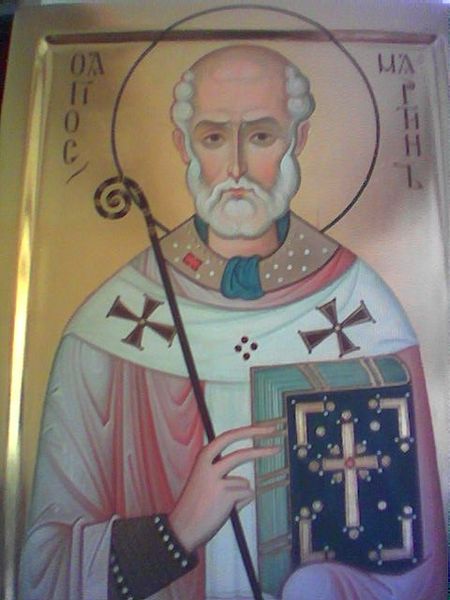 The Christian Almanac records that November 11 is remembered in the Christian Church as Martinmas in honor of Martin of Tours, a faithful bishop who was martyred on this day in 397 as well as Martin of Umbria who was also martyred on this day in 655. Both men endured great suffering, persecution, and personal humiliation for the sake of the gospel. According to legend, Martin of Tours once cut his own coat in half and shared it with a beggar. Apparently that part of his coat was later saved and preserved as a holy relic in France and even carried into battle by some kings. The cloak was later kept in a "chapelle" after the French word "chape" which meant "cape". The man in charge of the chappelle was the "chapelain". Of course we get the words "chapel" and "chaplain" from these happy occurrences.
Even this somewhat quaint story illustrates the significance of little acts of faithfulness. A coat for a beggar, speaking the truth, confessing sin or whatever other little act of obedience God may call us to is part of the great story of redemption. We now use the words chapel and chaplain throughout the world as a result of one man's charity, and one day the world will be filled with the knowledge of the Lord as the waters cover the sea as the result of the grace of God working in the lives of countless millions.
Monday, November 06, 2006
Raised for our Justification
In Romans 4 Paul says that Christ was crucified for our offenses and was raised for our justification. This is perhaps one of the most important statements about justification in all of Scripture. It establishes two very significant truths about this doctrine. First, that justification is a judicial act of God that so completely acquits of sin and every offense that we are not longer even under the power of death. Second, justification is something that took place in history, almost two thousand years ago. While we truly speak of our justification as the reality of God applying Christ’s resurrection to us in a personal way, we must never forget that our justification is in fact Christ’s justification. Christ was the innocent one, the just one, the righteous one, and therefore the grave could not hold him. Therefore, having faith in Christ means believing that his justification is our justification now, and that we will ultimately be raised from the dead like him. But this meal is a resurrection meal: it not only points back to crucifixion, it also points forward to marriage supper of the lamb, the great banquet following our resurrection. But we're eating it now! This means that this meal also signifies our justification. If we are eating the resurrection meal, then we have been raised up together with Him already and have been seated in heavenly places with Christ Jesus. Therefore rejoice: Christ was crucified for our offences and He was raised for our justification.
Mark 16: The Resurrection of the King
Introduction
Here we come to the end of the gospel, the resurrection of King Jesus. The final identification of who this man was. This is God in flesh, and therefore death could not hold him.
A Note about Manuscripts
Some of your Bibles may have verses 9-20 bracketed or perhaps you may even be missing them. Two of the earliest manuscripts that we have do not include the last 11 verses of Mark. The King James and versions that follow the ‘Received Text’ follow the critical work of Erasmus and before him the Byzantine tradition of manuscripts. While it would be foolish to be dogmatic about these things, there is value in placing greater trust in the church rather than the academy’s modern notions of ‘biblical’ or ‘textual criticism’. Mark may have added this portion to a later manuscript or authorized another disciple to complete the text. Or it may in fact be a much later addendum, but who are we going to trust?
The First Witnesses
Mark records that the first witnesses of the empty tomb are Mary Magdalene and Mary the mother of James. They intend to anoint the body of the Lord, but find a young man in white garments instead. While there is no explicit identification of the “young man” it is striking that the last reference to such a person is in the garden just after Christ’s betrayal and arrest. There, he left his clothes and fled naked; here he is seated peacefully and clothed in glorious raiment. While these two characters may not be the same person, the imagery is clear. Adam’s shameful nakedness has been clothed in a long white robe. The narrative of this episode ends with the women fleeing in fear and not telling anyone; this reminds us of the secret motif found elsewhere in the gospel. Yet, this time it is disobedience. Apparently Mary Magdalene came back to the tomb or perhaps never left altogether, but she is remembered as being the first witness of the risen Lord (v. 9-10).
Two or Three Witnesses
In the law, God required independent, collaborating witnesses to establish legal fact (Deut. 19). This high standard of justice is no less present here where there are two independent sources testifying to having seen Jesus alive (Mary and the two disciples). While the other gospels place emphasis in different ways, Mark is quite emphatic about the disciples’ unbelief. And this is what Jesus’ rebuke consists of when he finally appears to all of them, not believing those who had seen him. It is no accident that this rebuke is followed directly by the great commission. This rebuke is implicitly directed at those who would hear the preaching of the disciples, the likely first readers of Mark’s gospel.
Confirming the Word through Signs
Some have taken Christ’s words concerning signs to be a prescription for what belief looks like, and where these signs are missing belief must be absent. But we know that this is not the case because Acts records what belief looks like and it is not always accompanied by these signs and never all of them (e.g. Acts 13:13ff, ch.16-17), although all or most of these signs do show up at some point in the book of Acts. Church history confirms that these signs did often confirm the word of missionaries, and in Acts we see mini-Pentecosts breaking out as the gospel goes out from Jerusalem. But Mark’s last statement is important: these signs were confirming the Word. These signs are descriptive of what God sometimes sent (and sends) when the Word needs confirmation, but that is quite different from saying that these signs are prescribed for every last believer.
Conclusion and Application
Signs confirm the Word: this is the pattern of the sacraments confirming and attesting to what the word declares. Baptism affirms that we have passed from death into life through the life, death, and resurrection of Jesus. The Eucharist affirms that we are members of the New Kingdom and that the life, death and resurrection of Jesus Christ is the first fruits of heaven on earth. Genesis 1 attests to this patter: first the word then the created reality. The New Creation follows this same pattern as well: first the cross then the resurrection, first faith then good works.
A Realm of the King
This week our nation will hold elections and pass laws and select officials to rule over us. For many this is on of the great holy days of the year, the great religious feast and festival to their god Demos, the worship of the people, the worship of politics, the worship of democracy or the democratic process or whatever other names they conjure up to give their obeisance to. There are two important things for us as Christians to remember in this: First it is certainly good and right for Christian men and women to go out and vote for laws which uphold the Word of God and cast ballots for leaders who will do likewise. But we do not do these as acts of worship to their god. Their god is an idol of paper and numbers and polls and the evil hearts of men, but we serve the Triune God who rules over all. And that brings us to the second thing: we do not live in a democracy. We do not live in a republic. Our states and nations are all realms of the Kingdom of God; we live in a monarchy. Jesus is King over Asia and Europe and South America and Australia. Jesus is King over the United States. All of our political maneuvering and legislating is either in submission to the King or acts of treason. He rules the nations; God sits on the throne and does as He pleases. Therefore do not fear man; do not fear polls; do not worry about numbers; do not tremble at their idols of wood and stone. Fear God and honor His King. For His dominion is everlasting and His kingdom will never end. No election can ever change that.

Monday, October 30, 2006
No King but Jesus
Being members of the catholic church means that we are seated at this table with all the Christians throughout the world. We are seated here with liberal Anglicans, proud Roman Catholics, mystic Russian Orthodox, fundamentalist Baptists, cranky Presbyterians, and all kinds of other splinter groups that name the name of Christ in sincerity and practice the sacraments of the Christian faith. This means two things: first it means that we need to have a greater love for our brethren in every church, and pray God’s richest blessings on them. But secondly it also means that we need to stir up a greater hatred for the compromise and weakness evidenced throughout the Christian Church, and we need to begin with ourselves. One of the calls of the Revolutionary War was ‘No King but Jesus!’ And the same declaration needs to be made in all of life now. We will not pay homage to money, we will not pay homage to politics, and we will not pay homage to some generic, faceless god of Jews and Muslims. Our king was crucified 2000 years ago, and this is the feast of his coronation, the feast of his enthronement. So come and eat; come and drink; come and declare the crown rights of King Jesus.
Mark 15: The Victory of the King of the Jews
Introduction
This is the great Passover. Jesus is the house of God, the son and Israel of God whose blood turns the Angel of death away.
The Son of the Father
In 14:36 the “son of the Father” offers prayers in the garden. He cried out to God as “Abba” Father, and it is no accident that in the judicial proceedings that follow, Jesus is traded for Barabbas, a man whose name means “son of the father”. But of course the irony is that they came out to the Garden as though they were hunting a murderer (14:48) (when in fact they looked like armed thugs) and in the end a murderer is released to them. This “son of the father” is a revolutionary, a zealot, and Mark is portraying the High Priests and Jews as zealots and revolutionaries. And of course Jesus is crucified with thieves, being numbered with the transgressors (15:27-28). Here is God’s Son, Israel.
The King and the fools
This chapter and event can be presented as an enormous miscarriage of justice on many levels, but consider the fact of Pilot’s capitulation to these Jewish zealots and revolutionaries. The King of the Jews, the one who has come to establish peace and justice is being killed like a criminal, and the revolutionaries are being appeased and released. Pilot is a weak ruler and a fool. While knowing the truth, he cowers before violent men (15:15 cf. 15:9, 12, 16-20, 26). Even the location, the Praetorium, denotes the general’s tent or a palace or a seat of judgment. And the motif continues as Mark records three more attempts at mockery, all in some way testifying of the truth (v. 29-30, 31, 32). And this culminates with the centurion who declares, “Truly this man was the Son of God,” once again putting the truth in the mouths of the wrong people (15:39).
The House Desolate
We have considered how Jesus is the new temple and house of God. And here we see the final climax of that reality: when God forsakes Him, Jesus dies and the veil in the temple is torn from top to bottom. The murder of the Son is the great act that has finally driven God away. The reason the temple was defiled and destroyed in 70 AD is because Israel had already defiled the temple and destroyed it themselves some 40 years earlier. This is further emphasized by the fact that the temple curtain is torn in half. This is not merely the Most Holy Place revealed and accessed, but it is the Most Holy Place defiled, the temple spoiled and left desolate. Jesus is the temple, and therefore when Christ gave up the ghost, the veil was torn in half because the Spirit was leaving the temple.
Application & Conclusion
And this is the brilliant scheme of God to save and renew the entire world. God came down to destroy the works of darkness, to forgive our sins in this Great Passover, and then uniting us to Himself draw us up into the life of the Trinity. We would have done it differently, but God cannot be tamed. He bursts out of even the Holy of Holies, and now He fills and empowers His church with the resurrection life, the life of forgiveness and justice, the life of perfect freedom and glory. Jesus is Lord and King of all.
All the Saints
We have celebrated and will continue to remember All Saints Day and Reformation Day this week. And it is important to remember that these two holidays are not at odds with one another. It is not an accident that Luther posted his theses when he did. The Protestant Reformation was a cry for the saints, a plea for the priesthood of the plebians, the commoners. And while we are fully aware of how the church has splintered and fragmented over the centuries since, we must remain ever grateful for the faithfulness of a few men who would not back down from what the Scriptures taught. Nevertheless we must also remember the desire of the first reformers, the first protestants, to be catholic. They were not rejecting the catholic church, far from it. They were making all the ruckus because it had become clear that the Roman church had rejected the catholic church. This is what All Saints is; this is what Reformation Day celebrates: the cross of Jesus Christ, the atoning death of the one sacrifice which accomplished the forgiveness of sins and the salvation of the world, without which there is no catholic church; this is the ancient Christian faith once for all delivered to all the saints.
Saturday, October 28, 2006
A Catholic Reformation Day
This Sunday is Reformation Sunday, a day marking our gratitude to God for raising up Martin Luther and many other men and women after him who dared to throw tomatoes at the godless regime that had grown up within the Mother of us all, the Christian Church. In many corners of Protestantism this is a day celebrated as an equivalent to an Independence Day or worse still, a birthday, as though the great corpse of the Roman Church was finally dislodged and the pure Spiritual protestant church emerged all glorious and true. But for all our gratitude to God for Martin Luther, we must not forget what his own intentions were and the fact that the 95 Theses were posted on the eve of All Saints Day, the feast day of all those saints who gave their lives for the sake of the gospel. Luther's great protest, his burning of bulls and other generally outrageous behavior was not out of disdain for the Catholic Church but out of his great love for her. The Reformation from its inception was a cry for catholicity, not for sectarianism. It was a cry of loyal children for their dear Mother. Of course the legacy of both Roman Catholics and Protestant Catholics is neither glorious nor pure in this regard by any honest reckoning. But in the grand and humorous providence of the Trinity, the last five hundred years have been no mistake. Evil at points? Yes. Desperately wicked at times? Of course. A mistake? Absolutely not. The Reformation, like the Great Schism before it, is yet another way the Holy Spirit has been purifying and perfecting the entire Bride of Christ. And so as we come to celebrate Reformation Day, we do so with full recognition of All Saints Day on November 1st and All Souls Day on November 2nd, the feast of the martyrs and the feast of all the faithful. We celebrate the Protestant Reformation because it is yet another sign that God has been faithful and will continue to be faithful to His people. If it had been our Church, if it had been our planning and our scheming for the conquest of the world, it would have been far more boring, far more tame, and whole lot less messy. But the Triune God will not be boxed in by our little minds. He will not be hedged about with patrimonies and nationalistic powwows or sectarian ideologies or a pastor's fancy headgear. Our celebration of Reformation Sunday is a recognition of God's goodness throughout the centuries of the Christian Church in raising up faithful men and women who willingly gave up their own comfort, popularity, and often their very lives for the sake of the gospel. Our celebration of the Reformation is our recognition of God's faithfulness in every century to His people as the Church. As we seek to recover a culture of festivity and historic rootedness in the work of the Holy Spirit in the Church throughout the ages, we are seeking to celebrate the Protestant Reformation as Evangelical Catholics. And we invite one and all to join us, giving thanks to God for all of those who have come before and who God will still be pleased to raise up now and in the future, those who had the faith and courage to insist on the truth and authority of Holy Scripture and who had no qualms with giving pious sounding god haters a vigorous Bronx cheer.
Thursday, October 26, 2006
Monday, October 23, 2006
Greenville Pastors Fellowship
I just stumbled on to this. I haven't attended any of these meetings, but it looks like a great opportunity, and I look forward to being able to attend in the near future. I also added a link to this site on the side bar.
A Table for Traitors
This table is for all of God’s people, and it is important to note that is even for those whom God has invited but who later reject him. While there are many examples of apostasy in Scripture, one of the greatest is certainly Judas the betrayer of our Lord. While it is ambiguous in Mark’s account, Luke makes it more clear that Judas ate the Lord’s Supper with Jesus and the other apostles even though Jesus knew what Judas was planning to do. John indicates that at some point during the meal Jesus gave Judas a piece of bread and after that, Satan entered Judas. This is a glorious meal, a meal of grace and blessing, but it must never be forgotten that we are communing with the Lord Jesus Christ, the Lord of the Universe who knows the thoughts and intentions of everyone in this room. And you cannot fool Him. If He knew His own betrayer at His table 2000 years ago in an upper room in Jerusalem, you better believe he can see hypocrisy at any and every table in the world that invokes His name and presence. And the same warning applies. There are some false sons in the pale of Christendom, as the old hymn says, and there are some traitors in the ranks, but woe to those who think they can fool the God of all the earth. Woe to those who despise the goodness of God and clutch their vain idols of stone and wood. Remember, Peter and Judas both failed. Both of them failed miserably. But there is nevertheless a monstrous, horrifying chasm between them. Peter failed, but when the cock crowed he knew his sin and repented with tears. And while Judas later regretted his actions to some extent, we do not know of any repentance and all the indications are that he went down to the grave in self pity and loathing and darkness. All of you come; all of you eat. And do not eat in fear or dread, but consider this the cock crowing, and whatever sins you have been hiding, whatever sins you have been ignoring, whatever sins you have been clinging to let them all go now. Lay them down. Repent and place your trust in Jesus whose blood was shed for the forgiveness of sins. And in repentance come in full faith, in full joy, in full confidence. This is your salvation, even Jesus, the crucified and risen savior.
Mark 14:32-72
Introduction
We saw last week that Jesus is building a house in the fellowship of healed lepers, a house of God where the true sacrifice of His blood is shed for the remission of sins. This new house of Yahweh is the house of Israel that will be protected by the blood when the Angel of Death passes over. Jesus is keeping the Passover with his disciples.
The Garden of Gethsemane
Gethsemane means “oil press”. This reminds us that Jesus is the anointed one. We are told that Jesus goes to a garden in John’s gospel, and that is how we know that Gethsemane was a garden. It must not be forgotten that the first great betrayal in human history occurred in Eden, a garden on a mountain, and here, the last Adam is being betrayed in a garden on a mountain. The roles have been switched though: Jesus is the faithful, new Adam being betrayed by the old Adam (Judas). This presents the true nature of Adam’s first sin (and all sin). All sin is the implicit or explicit desire to kill God. Notice that after the actual betrayal there is a naked man running away in the garden; this is yet another echo of Eden where a man is fleeing in shame.
Prayer in the Garden
Jesus’ prayer here in the garden reveals a side of Christ that we have little witnessed to this point. If we look back at the gospel of Mark, Jesus is clearly pictured as a healer, a teacher, a scholar, a prophet, and a king, but here we see Jesus praying intensely. We are seeing God the Son as a human pleading with God the Father. This is a striking picture. Recall Jesus words to his disciples when they could not cast the demon out of the man’s son (Mk. 9:14ff). His response was “O faithless generation!” One is almost tempted to say, what about now Jesus? What about now? But this is not faithlessness in any way; instead it is faithfulness that turns to God in the darkest moments. And it is faith that both pleads with God and submits to His wisdom and grace. But consider this also a true reflection of the Trinity. Too often we mentally picture the Trinity like a ‘souped-up’ yin and yang. But the god of Eastern religion is a faceless force, impersonal energies ebbing and flowing in eternity. But we serve the Tri-person God, a God who in Christ pleaded with God the Father.
With Swords and Clubs
It is highly humorous and ironic that this mob comes out to fetch Jesus armed to the teeth. What were they thinking? Who are the robbers here, Christ praying in a garden or the mob with torches (ala John’s gospel) and swords and clubs? Of course one of Jesus’ disciples happens to be armed, and we are told in John’s gospel that it was Simon Peter who actually cut the ear off the high priest’s servant. It’s always an interesting study to see how the different gospels emphasize different aspects of the story: in this case, Matthew’s gospel emphasizes Jesus’ rebuke of the one who struck off the servant’s ear. John’s gospel tell us who it was (Peter), and Luke records that before they went out to the Mount Olives, Jesus had instructed his disciples to dress for travel and carry a sword, giving a plausible reason for why Peter was armed in the first place. Of interest to us is the fact that Mark gives none of these other details, but alone records the urgency of the disciples fleeing from the scene. Matthew does mention that the disciples fled, but Mark alone describes the young man who flees naked into the shadows. Mark is showing us the sheep being scattered, the temple being torn down.
Before the Sanhedrin
While they have great difficulty holding a judicial trial of the Lord, the one accusation that Mark records is that Jesus promised to destroy the temple and build another “made without hands.” As we have seen, Mark has made it abundantly clear that this is what Jesus is doing even though we’ve not seen it stated explicitly until this point. But the description is intriguing and should remind us of the book of Daniel yet again where Daniel tells Nebuchadnezzar his dream concerning the image which is destroyed by a stone cut out without hands that grows up into a mountain that fills the whole earth (Dan. 2:34ff). In an interesting parallel, once again it’s the wrong people declaring who Jesus is with the greatest clarity (cf. 1:24, 34, 3:11, 5:7).
Notice also it is ultimately Jesus who says what is necessary to invoke their guilty sentence. And he repeats what he has already told his disciples: he will ascend to the Ancient of Days in the clouds of heaven, fulfilling the prophecy of Daniel 7:13, to whom is given all power and dominion, a universal kingdom which will have no end. The high priest’s reaction is doubly significant. First, it is slightly humorous that he speaks as though he was getting somewhere with his witnesses (v. 63-64). Secondly, his actions are sacrilegious and prohibited by the law, for the high priest was explicitly prohibited by the law to tear his garments (Lev. 10:6, 21:10). This is an ironic action given what he is saying; he is enacting blasphemy even while accusing an innocent man of it.
The sign of having torn clothes is used throughout Scripture for those in great distress. It accompanies the death of loved ones and those who have barely escaped death (usually with bad news). But given the ceremonial context (the high priest’s action) we should remember the fact that torn clothes were the uniform of lepers (Lev. 13:45). Given the fact that we have seen Jesus’ actions in the temple as a leprosy inspection while dining with a healed leper (Simon) in Bethany, this imagery is hard to ignore. The high priest is a leper, but more importantly, their leprosy is not some ceremonial detail they have forgotten. Their leprosy is their rejection of Jesus. The rejection of the Messiah is their uncleanness and rejection.
Conclusion and Application
One of the hard but glorious things about the story of Jesus’ betrayal and conviction is the fact that meanwhile Peter is busy denying Jesus. This is a terrible, horrible sin, but the glory of it is that Jesus knew. Jesus knew that the flock was going to be scattered and that they would be made to stumble (14:27-30). Jesus knew that the house had to be broken down before a new one could be built. Remember Peter’s name means rock. And remember that God is still building His house with us today, and he’s using problem people like us, problem people like Peter. Therefore do not be haughty; be thankful and grow in grace.
You are Here for Prayer.
You are not here to be given a spiritual massage. You are not here to be entertained. You are not here to go through certain rituals or say certain words for their psychological side-effects. You are here for prayer. This means that you are here as priests and priestesses offering spiritual sacrifices for the salvation of the world. This means you may not bring any idols in here. Leave them all behind. Money cannot save you; it is lifeless paper and metal. A good reputation cannot save you; men grow old and die. Sex cannot save you and your body cannot save you; it will one day be dust. Politics cannot save you; God turns the heart of the king like rivers of water. Cast your idols down; repudiate them all; scorn them, and offer pure incense before the Most Holy Place. Gathering here for prayer also means that you are entering the council chambers of the King to be enthroned as kings and queens judging the world in righteousness. This means you cannot come in here with petty disagreements and quarrels with brothers and sisters. Do you not know that we are judging angels? Put your pettiness down and be enthroned here in the Kingdom. Finally, we are prophets and prophetesses giving counsel to God, speaking on behalf of the world, pleading with God like Abraham of old. This means you must come with confidence. You may not stand there muttering words apologetically as though you don’t belong here. You may not mumble the ancient and glorious mysteries of creeds and Psalms as though you’d rather be somewhere else. Because if you would rather be somewhere else, I would like to ask you to kindly leave now. Rather, we are entering into the Holy of Holies now; come with confidence, come with exuberance, and come with faith. Sing out loud like every song is for the world because it is. Shout your “amen’s” as though you would have God act and perform all that He has promised because you would. Pray the prayers with all the passion and faith you can muster as though God is listening to your every syllable; because He is. Listen to the Word of God read and preached as though He were speaking directly to you, as though your very life depended on every Word; because it does. Feast at His table with hearts full of thanksgiving as though the bread and wine were all of the energy and life of God made palatable for you; because it is. So come and worship. You are here for prayer.
Monday, October 16, 2006


The Architecture of Bread and Wine
We’ve talked about houses some today, and that in Jesus Christ, God is rebuilding a new house for himself to dwell in. We are that house, and through the power of the Holy Spirit, this meal is the hammer and nails of the project. Evangelism and baptism are the selection of the building materials, the reading of scripture and the declaration of the Word of God is the cutting and shaping of the timber to fit into the house in the right lengths and angles, and here at this table were being set in place. But you need to remember that we are all just blocks of wood. Pieces of wood don’t stand up on the shelves at the building supply saying ‘pick me! Pick me!’. And you certainly didn’t trim yourself to the exact right fit in the house. We didn’t do anything. God is the builder of His house; he picks the materials and he fits us into the house perfectly. And this table is proof that you’re in. You may have a sordid past; you may have sins that you are very aware that you are still fighting with and struggling against. The Christian life is a long term project. Think about our passage today and all the discussion of someone betraying Jesus; and the declaration that all of his followers will be made to stumble. But Jesus isn’t worried. You must confess the sin now, even now, and remember that God has already chosen you, and He has placed you here at his table in his house. You may be thinking what about this sin and that other sin and that one time when I… And He says to you, I don’t remember. You are my son, you are my daughter. And all of my children are righteous, clean and pure. This table is God’s grace to you, God’s favor, the proof that he has removed your sins from you as far as the east is from the west. And that means, he doesn’t remember.
Mark 14: 1-31: Jesus the Housebuilder
Introduction
Mark’s gospel is now drawing to its climax. Remember that Mark is concerned with royal themes. We’ve talked about the political/royal dimensions of the word gospel; we’ve also considered how Jesus’ teachings and parables are marks of a Solomonic king. But remember there has been a great deal of secrecy from the beginning of Mark only somewhat eclipsed by the declaration by Jesus that he will be betrayed and handed over to the Jewish leaders to be killed and raised from the dead.
Passover and Leaven
Notice the irony of it being Passover and the Feast of Unleavened Bread and the chief priests and scribes are plotting to kill the Son. The disciples are preparing for the feast in one way (14:12ff) while the Jewish leaders are preparing in another way (14:1-2). Remember that Jesus has warned his disciples of the leaven of the Pharisees and Herod (8:15). While these are perhaps not the exact same folks, it is plausible that there would have been some overlap. When the Jewish leadership should be getting rid of their bad leaven, they’re cultivating it.
Leprous Houses
Jesus is found “laying” in Simon the Leper’s house here in chapter 14. This particular word for “laying” is used several times at the beginning of Mark describing sick people. Simon’s Mother in Law was “laying” in her house sick with a fever in chapter 1 and the paralytic was “laying” on his bed when his friends let him down through the roof in chapter 2. Later in chapter 2 Jesus is “laying” at a feast with Levi and other tax collectors and sinners. This parallel is yet another indication that feasting and eating is part of Jesus’ identification with and ministry to the lost, the sick and the outcasts. Of course being in the house of a leper or (presumably) one who formerly was a leper is itself stigmatizing enough. Bethany is where Jesus as been staying the entire time of his teaching in the temple (11:1, 11-12), and perhaps he has been staying at Simon’s house for much of this time. Although we know that he spent at least some time in Mary, Martha and Lazarus’s house prior to this (Jn. 12:1-2). This would create an interesting parallel where Jesus is staying in the house of a cleansed leper while performing the inspection of the Temple according to the regulations for leprous houses in Leviticus.
Anointing the Head
Notice that the woman who anoints Jesus’ head parallels the widow who gave all that she had to the temple (12:43-44). But Jesus’ reaction is entirely different. If we remember that Mark’s gospel has pictured Jesus drawing a new Israel to himself then it is not too difficult to see these parallel stories pointing to the fact that Jesus is himself taking upon himself the status of the temple. The widow woman has been manipulated and/or robbed of her lively hood by conniving scribes, but this nameless woman has anointed the true temple that is about to be destroyed and rebuilt (14:58). John’s gospel indicates that this was the second time an incident like this had happened. It had occurred once (6 days before the Passover) prior to the triumphal entry where his feet were anointed (Jn. 12:1-8). But the anointing itself is another indication that Jesus is himself the new house of God because this is precisely how the Tabernacle was dedicated and consecrated (Ex. 40:9, Lev. 8:10).
The Widow’s Blood Money
Judas is betraying Jesus out of concern for money. Notice the ruckus is all over wasting money, but Judas has no problem taking money in exchange for Jesus. This of course proves that Judas didn’t give a damn about the poor people. And John’s gospel makes this clear. John tells us explicitly that Judas wanted the money for himself because he was a thief. The final proof of this is the fact that Judas is being financed by Temple money, money given by the widow who gave all that she had. This adds yet another layer to Jesus’ rejection of the Temple. Its destruction is being financed by widows. While there are many different kinds of trouble makers in the Church, we should recognize that greed and envy top the charts, and usually the trouble makers make their “concerns” known in the name of some high principle like caring for the poor and needy.
Another Triumphal Entry
When Jesus is asked about preparing for the Passover we see a very similar scene to when Jesus sent disciples for the donkey prior to his entry in to Jerusalem (11:2ff). One way to see this parallel is as a fulfillment of His enthronement. He came first as a king riding on a donkey amid shouts of acclamation, and now he is coming to the city once again as king to eat a royal banquet with his subjects (14:22ff). Another angle is to see the first entrance as a type of this second entrance. Jesus is king, but his enthronement is not like the kings of this world. His enthronement is in a meal with his disciples and his betrayal, death, and finally his resurrection. This would add to some of the temple imagery as well. Jesus came the first time in the garb of a king and symbolically condemns the temple and prophesies its destruction. Jesus comes a second time and enacts a sacrificial meal with his disciples signifying the arrival of a new temple where His blood is shed for many (14:24).
The Temple’s Destruction
While Jesus and his disciples are on their way out of the city to Gethsemane, Jesus tells his disciples that they will stumble in fulfillment of a prophecy from Zechariah. Consider Zechariah 12-14 where Jesus is quoting from (Mk. 14:27 is from Zech. 13:7). The passage is apocalyptic and certainly not an easy read, but it is clearly seen that there is simultaneous destruction and redemption of Judah taking place wrapped up in the event of the Pierced One (12:10) and the Shepherd who has been struck (13:7) and this event will establish Yahweh’s rule over all the earth (13:9). Remember this is the same book that Jesus has only recently signified in his entry into Jerusalem (Zech. 9:9). Given the close identity with Jesus and his actions with the Temple, it is not too much of a stretch to see Jesus’ own death and resurrection as the beginning of the destruction of the Temple. Jesus is fulfilling Zechariah’s prophecy, and it will result in Yahweh’s house being cleansed and purified (Zech. 14:21).
Conclusion and Application
From Creation to the end of the world, it can be argued that God’s main objective has been to build a house for himself. God is a house builder; this should give hope to us.





 Posts
Posts

